Riemann hypothesis
The HumansThe Riemann hypothesis is the great mathematical problem at the center of Andrew Martin’s breakthrough and the narrator’s mission to erase its proof. It is presented not only as a question in mathematics but as a threshold: solving it might open new paths for civilization, while suppressing the solution means deliberately closing those paths. The narrator first treats the proof as dangerous evidence to destroy; later, as he reads Andrew Martin’s work, he grasps the scale of what that destruction may cost.
The Problem and Its Promised Reach
The book identifies the Riemann hypothesis as mathematics’ most important unsolved problem. It does not provide a technical account of the hypothesis itself; instead, its significance comes through the hopes attached to solving it. In the introduction to the proof, mathematical understanding is described as a foundation of civilization, built through advances that have arrived unevenly, with periods of rapid development and severe setback. The history of mathematics becomes a history of possibilities deferred as well as realized.
The argument in that introduction reaches backward to the burning of the Library of Alexandria and imagines how much earlier human achievements might have followed had ancient knowledge survived. It speculates that mathematical progress could have brought space travel, the colonization of other planets, medical advances, and perhaps a means of preventing aging and death much sooner. These are presented as conjectures about what mathematics might make possible, not as outcomes guaranteed by the Riemann hypothesis. The proof’s importance lies partly in this uncertainty: its consequences are described as potentially immense and not yet knowable.
The introduction also gives the problem a place in a succession of mathematical challenges. As other famous riddles, including Fermat’s Last Theorem and the Poincaré Conjecture, were solved, the Riemann hypothesis came to stand as the last and largest problem. The text compares its solution to a major change in what can be understood about the physical world, and links it to possible advances in computation, quantum physics, and interstellar transportation. The comparison conveys the scale of the hoped-for leap without claiming that each imagined application has already been achieved.
Andrew Martin’s Proof
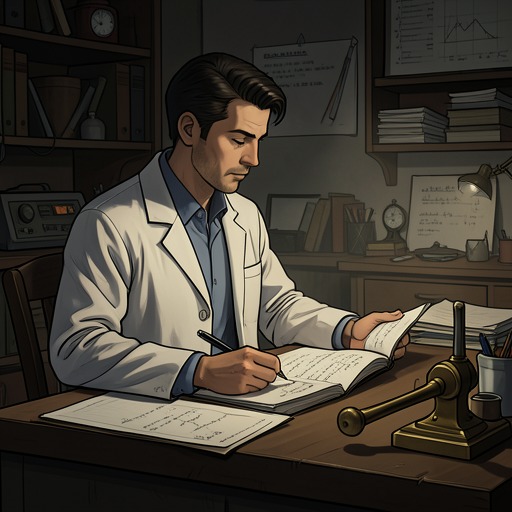
The narrator finds the proof while searching Andrew Martin’s computer for evidence of the breakthrough. The document is called Zeta and runs to twenty-six pages, most of them mathematical symbols. Its opening identifies it as a proof of the Riemann hypothesis. The contrast between a short written introduction and pages of unfamiliar notation makes the discovery both legible and remote: the narrator can recognize what the document claims to be, but must still work through a mathematical language he has not previously learned.
After reading the introductory material, he examines the numerical and symbolic pages. He describes mathematics as easier and more truthful to learn than the human language he has been acquiring. At the end, a final infinity sign convinces him that the proof is complete and that the problem’s lock has turned. This is the narrator’s assessment of the document as he reads it; the passage gives no independent mathematical verification. Nevertheless, within the story, Andrew Martin has achieved what generations of mathematicians had not.
The discovery carries a personal as well as a historical dimension. The narrator later reads Andrew Martin’s thin, uncorrected proof copy of The Zeta Function, which had been written before the breakthrough. The book recounts Andrew Martin’s effort to explain the pattern in the spaces between prime numbers and, to the narrator, reveals how deeply he wanted to solve the problem. The gap between the book’s account of an apparently futile quest and the later proof makes the discovery feel like the fulfillment of a long pursuit—and makes its destruction harder to regard as a merely technical act.
Erasure and Its Cost
The narrator’s assignment is to halt human progress by removing evidence of the breakthrough, including evidence held in living people as well as in computers. When he finds Zeta, he deletes it, initially feeling a small surge of pride and telling himself that he may have saved the universe. The claim reflects his mission’s logic: a mathematical advance could threaten the established order, so destroying the proof appears to him at first like prevention.
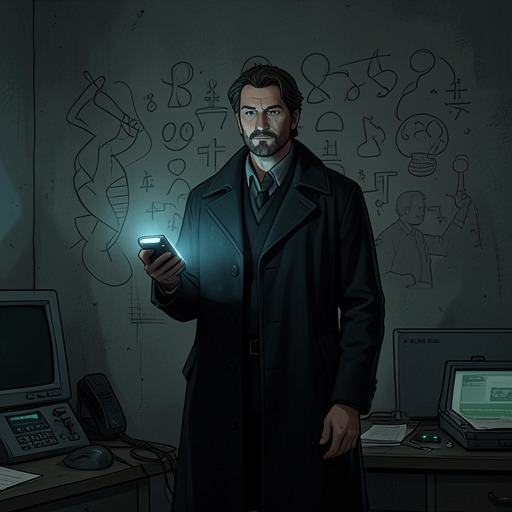
He also removes the message and attachment sent to Daniel Russell, then designs a virus using prime numbers to make the computer’s contents inaccessible intact. These steps extend the erasure beyond one file. The proof is not simply hidden from view; the narrator tries to prevent its recovery through the electronic trail that connected it to another mathematician. The use of primes in the virus is an ironic detail: mathematical knowledge helps him obstruct the dissemination of a mathematical breakthrough.
His judgment changes when he returns to Andrew Martin’s office and reads The Zeta Function. The book’s account of human achievements—from fire and the plough to the printing press, the steam engine, the microchip, and the discovery of DNA—sets the proof within a much longer history of cumulative change. The narrator compares this human sequence with his own civilization’s mathematical leap, which enabled interstellar travel, transformations of the body, long life, and access to other minds. Against that comparison, destroying the proof no longer seems like the removal of a dangerous document. He recognizes that he may have killed off humanity’s future possibilities.
Mathematical Progress and the Story’s Conflict
The Riemann hypothesis connects the novel’s central conflict to a mismatch between technical progress and psychological maturity. In the narrator’s account, humans have developed rockets, probes, and satellites but have not yet made the larger advances he associates with the proof: synchronized minds, free-thinking computers, automation, and travel between galaxies. Mathematics appears as a means by which civilization might cross those thresholds, while the narrator’s mission is to keep that crossing from happening.
The proof’s importance also changes as the narrator’s understanding changes. At first, he approaches it as evidence to eliminate under orders that take priority over its value to the people who created it. Reading Andrew Martin’s book forces him to see both the desire that preceded the discovery and the wider chain of human achievements into which it could fit. The same document thus functions first as a target, then as a measure of what the narrator’s intervention has taken away.
The story keeps the proof’s promise distinct from its realization. The narrator recognizes a completed proof and imagines consequences that might follow, but the text does not show those technological futures arriving. What it does show is the choice to destroy the work and the narrator’s later recognition of the cost. The Riemann hypothesis therefore stands at once for a specific mathematical achievement, for human possibilities that remain unrealized, and for the danger of deciding that progress can be safely stopped by erasing its evidence.